Small Parts, Long Tail: Turning Repair Café Referrals Into a 3D Commission Pipeline
The knob on a 1980s dryer snaps off in your hand. The appliance still heats, still tumbles, still has life left. The replacement part was discontinued years ago, and the forum thread ends with a shrug. That’s the moment a repair café volunteer starts hunting for someone with calipers and a CAD program. In 2026, that someone can be you.
Right-to-repair has moved from bumper stickers to statehouse hearings, but the practical backlog is still measured in small plastic bits: knobs, clips, bezels, handles, hinges, feet, latches, and trim. Big manufacturers aren’t rushing to resurrect every part number. Repair cafés and independent technicians are filling the gap with used parts, improvisation, and—increasingly—3D printing and small-batch machining. If you want a niche that’s less crowded than another sci-fi helmet, this is a good place to set up a desk.
Start Where the Parts Bin Ends
Repair cafés are the front door. They’re usually volunteer-run events in libraries, churches, and community centers where people bring broken toasters, lamps, vacuums, and sewing machines. The volunteers can fix a lot, but they hit a wall when a custom plastic piece is missing. That wall is your intake form.
Show up with a folding table, a caliper, a small laptop, and a sign that says “obsolete parts measured free.” Don’t lead with 3D printing. Lead with measuring. Volunteers and technicians care about fit, function, and whether the repair will hold. The printing is just the delivery method.
Independent appliance technicians are the second front door. Their trucks and back rooms are full of “can’t get the part” jobs: a refrigerator door handle, a washing machine dial, a stove bezel with a cracked corner. Ask if you can photograph their dead-parts shelf. Offer to model one part free in exchange for permission to use it as a case study, minus any customer details. That first free part is marketing, not charity.
Other sources: vacuum repair shops, sewing machine mechanics, HVAC contractors, boat yards, and the maintenance departments of small apartment complexes. All of them deal in discontinued hardware and all of them hate throwing away an otherwise serviceable machine over a $4 piece of plastic.
Document Like You Mean It
A repair part is not a sculpture. It has to mate with something. Your documentation needs to capture the mating surfaces, the travel of the knob, the detent feel, the thread pitch, and the material. Build a simple part passport for every commission: photos with a scale, a dimensioned sketch, tolerance notes, material callout, and the failure mode.
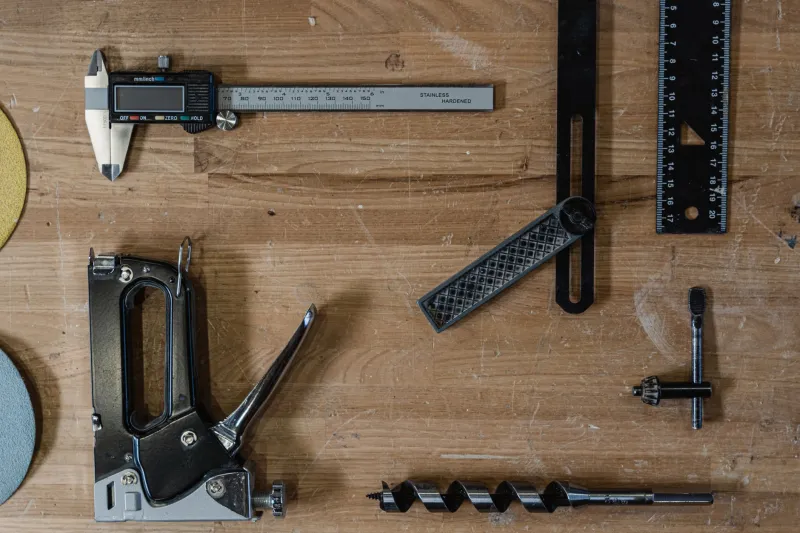
Use calipers, radius gauges, thread pitch gauges, and feeler gauges. For awkward geometry, take a silicone impression or a photogrammetry pass, but verify critical dimensions by hand. A scanner gives you a shape; calipers give you a fit.
Tolerances should match the job. Cosmetic bezels and covers can live at ±0.2 mm. Press fits, snap tabs, and shaft bores need tighter attention, often ±0.1 mm or better depending on the material. Threads need clearance; don’t model a male thread and expect it to screw into a molded female thread without testing. Print a test coupon first. PLA is fine for checking fit, but final parts in a hot appliance or outdoor setting may need ASA, PETG, polycarbonate, or a nylon-carbon blend. If the part will be machined, note the stock size and the operations so the machinist isn’t guessing.
Photograph the failure too. A cracked bezel tells you where the stress lives. A stripped knob tells you whether the spline was undersized or the user was heavy-handed. That context belongs in the passport and in your portfolio write-up.
The Patent and Trademark Tightrope
This is where enthusiasm meets a lawyer’s business card. You are not the lawyer. But you can build a sane workflow.
In the US, design patents protect ornamental appearance, and they expire—generally 15 years from grant for designs filed on or after May 13, 2015, and 14 years for older ones. Trademarks can last indefinitely, but they protect source identifiers, not functional shapes. A generic knob shape is usually not the problem. A branded logo molded into the knob is a different conversation.
For one-off repair commissions, the practical move is to model the functional part, omit or replace brand marks, and document that the part is for repair of a customer’s existing appliance. Don’t scan a branded part and sell it on a marketplace as a replacement. Don’t promise a client that your part is legally identical to the OEM part. If the shape is distinctive and the patent may still be alive, redesign the visible surfaces enough to be clearly your own while keeping the mounting geometry functional. Put the scope in writing: “replacement part for repair use, not an OEM replacement, no brand marks reproduced.”
If a repair café wants a batch of twenty knobs for its own event, that’s a different scale than a national parts store. Keep the batches small, keep the records, and ask before you assume. When in doubt, get the client’s written confirmation and talk to an intellectual property attorney who knows product design.
Price the Small Batch, Not the Hour
Small parts are not small work. A knob may take two hours to measure, model, test, and print, plus a revision. If you charge $30, you’ve bought yourself a hobby. Build a simple ladder: a setup and documentation fee, a per-unit price, and a minimum order.
A reasonable starting point in the US market: $75–$150 for measurement and CAD documentation on a simple part, then $12–$25 per printed unit in small batches, with machined or high-temperature parts higher. Complex bezels, multi-part assemblies, and parts that need multiple test fits go up from there. Charge for test prints. Charge for revisions caused by changed requirements, not by your own mistakes. Include shipping and a clear lead time.
For repair cafés, offer a “parts desk” retainer: a fixed monthly block of measurement time and a discounted per-part rate. For technicians, offer a rush tier and a standard tier. The goal is not to be the cheapest; it’s to be the person who answers the phone when the part is obsolete and the customer is standing at the counter.
Build the Referral Loop
Every repaired part is a portfolio piece with a built-in story. Photograph the broken original, the model, the test fit, and the installed part. Get permission from the repair café or technician to use the images, and keep customer names out of it. Write a short case study: the appliance, the failure, the constraint, the material choice, the fit result. Post it where technicians actually look—local repair groups, trade forums, and your own site.
Give repair cafés a stack of cards with a QR code to your parts desk and a one-page list of the parts you’ve already solved. Ask technicians to text you a photo of the next dead part. Turn that into a monthly “obsolete part of the month” post. The referral loop is simple: the volunteer remembers you measured the knob for free, the technician remembers you delivered a working part in a week, and the next customer hears “I know a person.”
The barrier to entry is a Saturday, a caliper, and the willingness to ask a volunteer what failed. The long tail is every appliance in America that’s one small missing piece away from the landfill. That’s a niche worth modeling.