Bubble Wrap Is Not a Preservation Plan: Scanning Holiday Villages While the Lights Are Still On
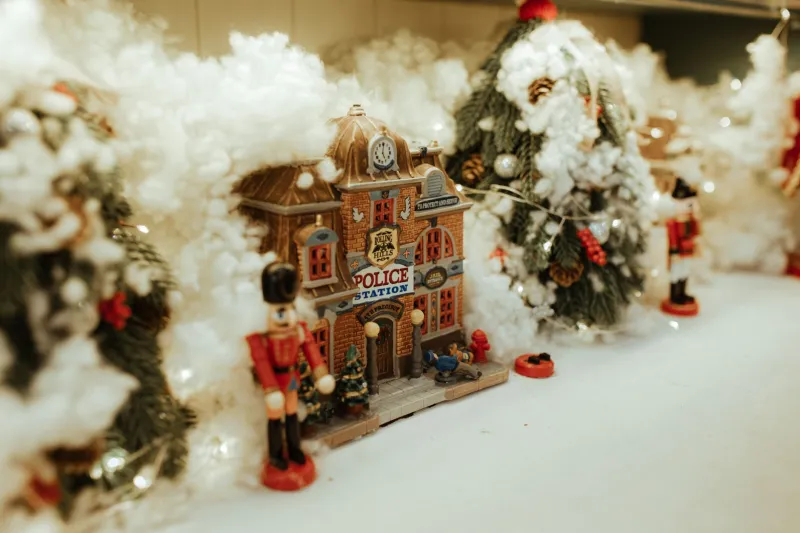
Every holiday village has a deadline that has nothing to do with shipping. The miniature brick depot, the ceramic gazebo, the train layout in the bank lobby—they go up fast in November and disappear into bubble wrap and banker boxes by the first week of January. For 3D artists, that narrow window is a commission opportunity hiding in plain sight. The work is not just a pretty turntable for social media. It is a reusable asset set, an archival record, and sometimes the only way a collector can share a fragile display without risking fingerprints or a snapped chimney.
Call it a holiday capture sprint: a short, tightly scoped scan-to-mesh job for tiny, glossy, light-filled objects. Here is how to run one before the boxes come out.
Why Tiny Holiday Scenes Break Normal Capture Habits
A holiday village is a hostile environment for casual photogrammetry. The subjects are small, often ceramic or painted resin, and usually packed with reflective windows, tiny figures, and a tangle of LED strings. Depth of field collapses at macro distances. Glossy roofs throw hotspots. Warm-white LEDs flicker just enough to smear color between frames. And the layout itself is often a dense cluster of buildings, track, snow batting, and loose accessories that nobody wants you to rearrange.
The fix is not one magic setting. It is a slower capture plan. Treat each building as its own scan subject, then capture the layout as a separate wide asset. Use a macro-capable camera on a tripod, a circular polarizer, and a diffused constant light or cross-polarized flash setup. A color checker and a small scale bar belong in the first and last frames. If the owner allows handling, use gloves and move only what is already meant to move. Never spray matte coating on a collectible. Never add tape or fiducials to a painted surface. When in doubt, capture more angles rather than touching the object.
The Scan-to-Mesh Workflow That Respects the Object
Start with a written handling agreement. It should name who moves the pieces, what surfaces can be touched, how long the capture takes, and what happens if something chips. For small museums and historical societies, this is often the difference between a yes and a polite no. They are not protecting a prop; they are protecting a donation.
For each building, shoot 60 to 120 overlapping frames in a full orbit, plus roof and side passes at a lower angle. Keep the background plain and the lighting consistent. If the object has a glossy glaze, polarize the light source and the lens, then check for hotspots on the back of the camera before you commit. If the windows are translucent, capture two states: lights off for surface color and geometry, lights on for emission reference. Do not expect photogrammetry to solve glass. Model window panes as separate simple meshes and assign emissive materials in Blender or your DCC tool of choice.
After alignment, clean the dense mesh, retopologize to a game-ready budget, and bake ambient occlusion and normal detail from the high-resolution scan. Keep the tiny stuff separate: the wreath on the door, the station clock, the snowman with the crooked hat. Those small props are reusable assets on their own, and they are often what buyers remember. Export glTF for web review, USDZ for quick AR previews, and OBJ or FBX for downstream clients. Add a metadata sheet with dimensions, capture date, material notes, provenance, and rights language.
Lighting Passes and the Gloss Problem
Holiday displays are designed to be seen lit. That makes them beautiful in person and annoying in a scan. Build a two-pass habit. Pass one is geometry and albedo with the display lights off and even, diffused illumination. Pass two is an emission reference pass with the lights on, shot from the same angles at a fixed exposure. In post, use the second pass to rebuild window glow, lamp warmth, and the little pools of light on synthetic snow. Do not bake the LEDs into the base color unless you want every future render to look like December.
Department-store window displays add another layer: glass. Reflections from the street, interior spotlights, and passing shoppers will contaminate a scan. Ask for access before opening hours or after closing. Bring black cloth to kill reflections, shoot at an angle to the glass, and use a polarizer. If the window cannot be opened, capture the scene through the glass as a reference panorama and rebuild the hero pieces from object-level scans. That hybrid approach is usually faster and cleaner than pretending you can scan a whole window through plate glass.
Pitching the People Who Own the Bubble Wrap
The best prospects are not big toy companies. They are local collector clubs, small historical societies, Main Street associations, independent museums, and the department store that still puts a train in the window. Pitch before the displays come down. By mid-November 2026, many displays are already up, which means the clock is running. Offer a simple package: one hero building, one layout panorama, and a short AR preview for the organization’s website. Price it as a fixed-scope commission, not an open-ended scan session.
Be clear about rights. A collector may want a personal digital keepsake. A museum may want an archival master and a web viewer. A Main Street group may want social clips and a browser walkthrough. Those are different licenses, and they should be priced differently. Deliver a clean folder, a contact sheet, and a one-page readme. The assets should be usable without you in the room six months later.
The January Regret Tax
Every year, someone waits until the first week of January to call. By then the village is in boxes, the train is off the track, and the window has been stripped to bare mannequins. The scan can wait, but the object cannot. A holiday capture sprint is a small, seasonal pipeline job with a hard deadline and a genuinely useful output. Get the permissions, bring the polarizer, shoot the lights both ways, and hand over files that outlast the tinsel. Bubble wrap is storage. It is not a preservation plan.